

50 Moral and Ethical Questions to Ask
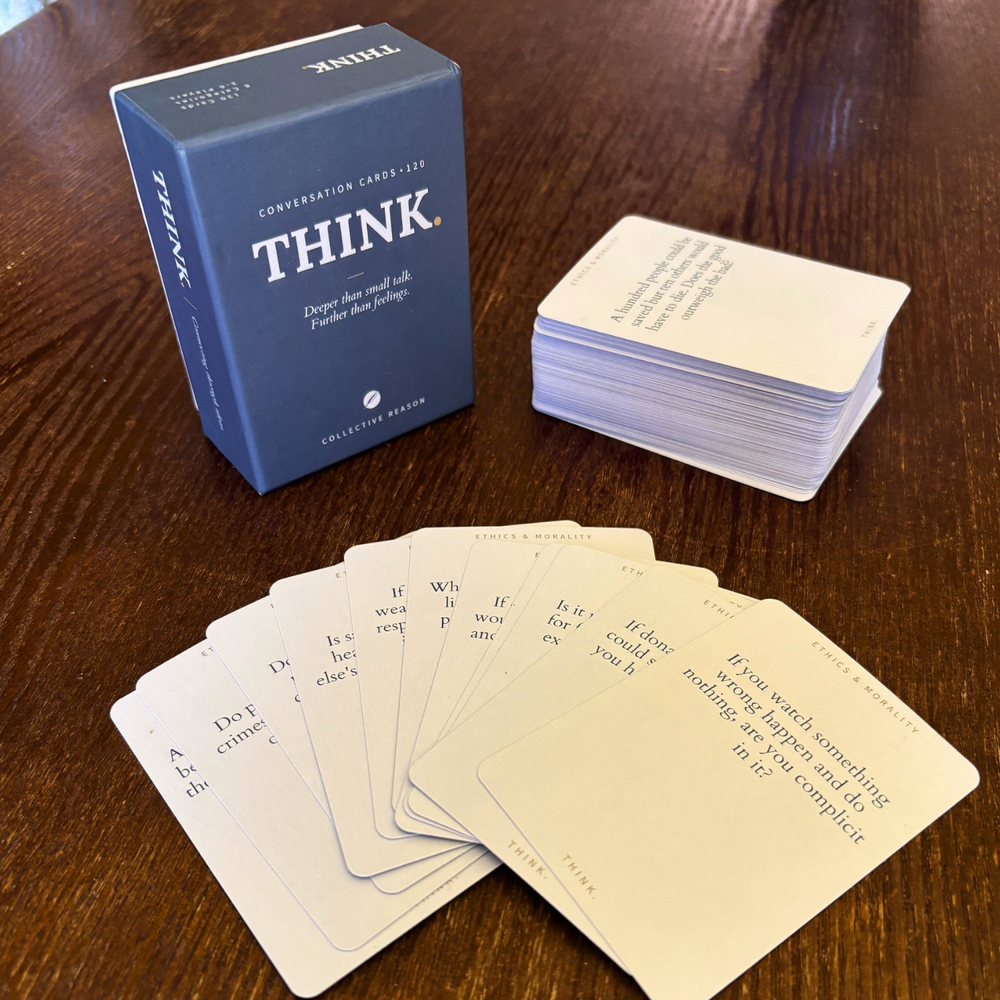
Most lists of ethical questions have the same problem. The questions are fine. You ask one, someone gives you an answer, everyone nods, and then the conversation stops. Thirty seconds of thinking, and you're back to talking about the weather.
The question was never the hard part. What's hard is the second move — the thing you ask to keep the conversation going.
This list does two things. Below are fifty moral and ethical questions grouped into nine themes, ending with ten proper dilemmas. After them is the part that actually matters: how to ask them so the conversation goes somewhere.
What makes a question an ethical question?
An ethical question asks what you should do, or what makes an action right or wrong, as opposed to what you'd like to do. "Would you take the money?" is a preference. "Should you take the money, knowing where it came from?" is an ethical question.
A good ethical question has three properties:
- More than one honest answer. If there's one clear answer, it's a quiz, not a question.
- A cost on both sides. The interesting ones make you give something up whichever way you go.
- Somewhere to go next. You can change one detail — the amount, the relationship, the distance — and watch the answer move.
How to ask them so the conversation actually goes somewhere
Five things:
- Ask, then stop talking. The silence after a real question is the question working.
- Listen intently. Most of us listen for the gap where we get to say our own thing. Listen instead for the reason underneath the answer, because that's what you'll want to ask about next.
- Move one detail and ask again. A hundred people saved and ten lost — now make it a thousand and ten. Now make one of the ten your brother. You're finding where the boundaries of belief lie.
- Don't judge. Your job is to be curious about the answer. Let the other person think it through, let them fumble, let them say things they might've never said out loud. That's where it gets interesting.
- Make it easy to change your mind. Say "I don't know" when you don't. Say "okay, that changed things" when it does. Real thinking is messy. Embrace it.
50 moral and ethical questions, by theme
These come from the THINK. conversation card deck. Most are questions from the cards exactly as they're printed. The rest are follow-up questions on the cards, repurposed here to standalone. Feel free to use them, print them, take them to a classroom. That's what they're for.
Right and wrong, head-on
- Do your good intentions matter if what you did caused harm to someone else?
- If you watch something wrong happen and do nothing, are you complicit in it?
- A hundred people could be saved but ten others would have to die. Does the good outweigh the bad?
- When is lying acceptable, and when isn't it?
- When does a law stop being inconvenient and start being genuinely wrong?
Mind, body, and medicine
- One heart is available. A child with a genetic condition needs it, but so does a lifelong smoker who's been waiting longer. Who gets it?
- Should a person with a terminal illness have the right to choose when and how they die?
- Should people be allowed to sell their organs?
- What do we owe someone who no longer understands what's real?
- If a drug alters someone's mind, are they still responsible for what they do?
Money, work, and who deserves what
- When a company makes life cheaper and more convenient but pushes out small local businesses in the process, should we view that as a win or a loss?
- If you buy products made by exploited workers overseas, are you responsible for the harm in any way?
- When you see someone who's poor, what do you most often attribute that to: a personal failure or a failure of the system?
- Does how long someone has worked for you create an obligation beyond their contract?
- At what point does taxing the wealthy stop being "contributing more" and start being taking someone's money?
Power, law, and the state
- Should every citizen have the right to vote — even someone who doesn't know what they're voting on?
- Would you allow the government to access your private information if it helped to prevent terrorism and crime?
- What's worse: misinformation on the internet, or the government saying what can and can't be posted?
- At what point does government control during a crisis become too much?
- Is it ever right to cut ties with someone you love over a political belief?
Technology and the things we're building
- Brain implants are already in human trials. At what point would you consider one for yourself?
- A city uses AI to predict crime before it happens. If it works, would you have any problem with it?
- Growing babies in artificial wombs: progress or a line we shouldn't cross?
- Should there be decisions only a human is allowed to make, even when a machine is less likely to get them wrong?
- Would we lose something that matters about being human if we got rid of negative emotions?
Animals, land, and conservation
- What do we owe the people who will live on this planet after we're gone?
- Is it right to kill an animal for food if that animal can experience emotions like love, fear, and pain?
- You could build a warehouse to create much-needed jobs for your town or preserve the local forest it'll be built on. Which do you choose?
- Why do we value pets and people over other lives? Is that anything more than a bias?
- Is protecting nature a luxury — something that only matters once your own needs are met?
Culture, history, and social issues
- Your country harmed another group generations ago, but the group still struggles to this day. What, if anything, do the people alive today owe them?
- Is it fair to judge historical figures by today's standards?
- When a statue means pride to some and pain to others, what should society do with it?
- Have you ever changed your mind about something you were raised to believe — and what changed it?
- Has a joke ever crossed a line for you? What exactly made it go too far?
Faith, meaning, and what it's all for
- Is suffering always bad, or can it sometimes be meaningful?
- Do our lives have any purpose if there's no God to direct them?
- If religion makes you happier, healthier, and more connected, does it matter whether any of it is true?
- Can something be true even if it can't be proven?
- If someone close to you kept trying to convert you, what would make it feel caring rather than disrespectful?
Ten moral dilemmas
A moral dilemma isn't just a hard question. It's one where every option costs you something you actually care about — so you can't answer it without saying which of your own principles matters more. That's what makes them worth asking out loud.
Dilemmas with a cost either way
- A parent loses their job and begins stealing food to feed their children. Is this kind of stealing excusable?
- You're on your way to the biggest opportunity of your life when you see someone get injured. Do you stop and risk losing the opportunity?
- If doing the right thing would cost you your career and put your family at risk, would you still do it?
- Is sacrificing your own health to save someone else's life noble—or reckless?
- What would you rather do: live a selfless life and be poor, or live a selfish life and be rich?
And what they reveal
- If stealing was the only way to keep your own kids fed, what would you honestly do?
- Is there anything worth standing up for no matter how big the risk?
- Is it ever right to force someone to share their wealth — and how is that different from stealing from them?
- Do people lose their rights when they commit crimes, or should some rights be guaranteed no matter what?
- Why do we admire sacrifice — is there some deeper principle, or is it just what we've learned to think is good?
The follow-up is what makes it work
Here's the difference between a question that fills two minutes and one people bring up again a week later. This is question 6 above, printed exactly as it appears in the deck — the question on the front, the three follow-ups on the back.
One heart is available. A child with a genetic condition needs it, but so does a lifelong smoker who's been waiting longer. Who gets it?
On the back
- Should all lives be valued equally in medical decisions, or do things like age, lifestyle, and status matter?
- Should how long someone has been waiting ever matter more than who's most likely to survive?
- If you were the smoker and knew about the child who needed the organ, what would you do?
Almost everyone picks the child in under a second. Watch what the three follow-ups do to that.
The first makes them state a principle, which is a much bigger commitment than picking a name. The second sets that principle against a competing one they also believe. The third takes the whole thing and puts them inside it.
That's the pattern: raise the stakes, ask for the principle, then bring it home. Once you've seen it you can build it for anything on this page. Take question 5 — when does a law stop being inconvenient and start being genuinely wrong?
- Raise the stakes. What if breaking it would cost you nothing at all — would that change whether you should?
- Ask for the principle. What makes a law binding: that it's just, or that it's the law?
- Bring it home. Is there any law you're already breaking?
Three follow-ups and the conversation goes somewhere it wasn't going to go.
Quick questions
What's the difference between an ethical question and a moral question?
In ordinary use, very little, and most people use the words interchangeably. Where a distinction is drawn, moral tends to mean an individual's sense of right and wrong, and ethical tends to mean the agreed upon standards of a group or profession — medical ethics, legal ethics, a company's code of ethics. Every question on this page works under either label.
What is a moral dilemma?
A moral dilemma is a situation where every available choice breaks something you believe. It isn't a question with a hidden right answer you're supposed to find — it's a question where answering means ranking two of your own principles against each other. The organ question above is one: you probably believe both that need should decide and that fairness to whoever waited longest should decide, and only one of those can win. That's the whole design. Questions 41 to 50 on this page are the clearest examples.
What are good ethical questions for a classroom or discussion group?
The ones where the room will genuinely split. A question that produces unanimous agreement wastes the period. From the list above, numbers 6, 16, 22 and 28 reliably divide a group without anyone taking it personally, because the disagreement is about a principle rather than about the people in the room. Give everyone thirty seconds of silence to think it through before anyone speaks.
Will questions like these start a fight?
They're written not to. Every question above is framed so that more than one honest answer is available, and none of them is set up so one position is obviously the correct one. That's a design choice, and it's the difference between a question that opens something up and a question that's really an accusation wearing a question mark. You can disagree with someone at this table and still want them back next week.
Where do these questions come from?
They come from THINK., a conversation card deck I made: 120 cards across eight categories, one question on the front and three follow-ups on the back — close to 500 questions in total. Twenty-nine of the fifty above are card text exactly as printed. The rest are follow-ups from the backs of cards, reworked to read properly on a page instead of in someone's hand. The card in the section above is a complete one, front and back, exactly as it ships.
THINK. is 120 conversation cards for people who'd rather talk about ideas than feelings — eight categories, one question per card, three follow-ups on the back. See the deck →
