

Conversation Cards vs. Relationship Decks vs. Party Games: What You're Actually Getting
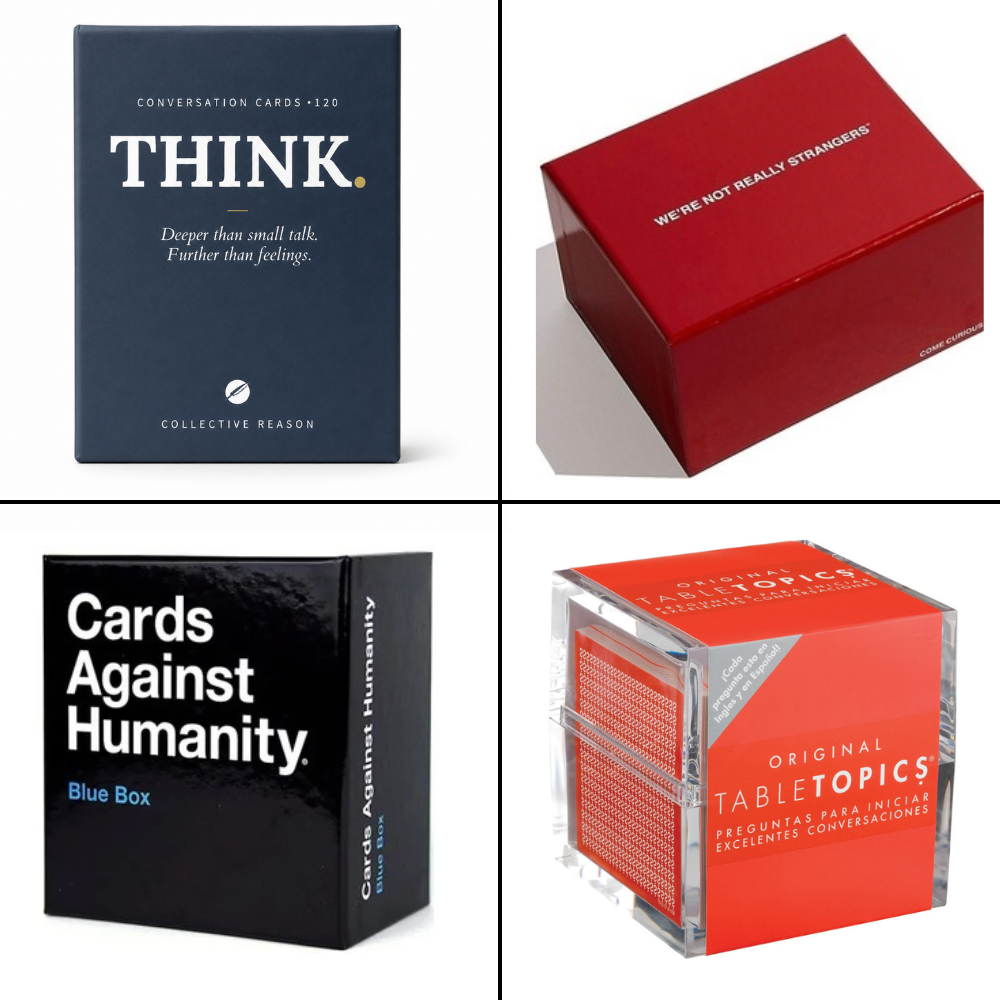
Walk into a gift shop and you'll find three genuinely different products shelved as one category. A deck built to deepen a relationship, a deck built to loosen up a party, and a deck built to make people think hard about real questions — all filed under “conversation starters,” all in similar boxes, all promising some version of better conversations.
They're not interchangeable. Buy the wrong one and you'll get a fine night, just not the one you were after. Here's what actually separates them.
What's the difference between conversation cards, relationship decks, and party games?
Relationship decks surface vulnerability between people who already know each other well. Party games lower the temperature in a room of near-strangers. Conversation cards sit between them — and the strongest ones are really critical thinking decks, built to get people to take a position on something real.
The mechanism, the intimacy level, and the kind of thing you learn about someone are different in each case.
| Deck type | Built to surface | Best for | Example decks |
|---|---|---|---|
| Relationship decks | Vulnerability, personal history, emotional intimacy | Established couples, close friends, check-ins | We're Not Really Strangers, BestSelf Deeper Talk Deck, Our Moments |
| Party games | Energy, laughter, low-stakes participation | Mixed groups, first meetings, icebreaking | Cards Against Humanity, Loaded Questions, Hot Seat |
| Conversation cards | Opinions, stories, and something to talk about | Dinner tables, road trips, broad-appeal groups | TableTopics, Cards & Conversation, Actually Curious |
| Critical thinking decks | Beliefs, values, and where someone actually stands | Discussion groups, seminars, classrooms, friends who want to go further | THINK., School of Life Philosophical Questions |
The last two rows are the split most people miss. Both are sold as conversation cards. Only one of them is designed to make you defend a position.
What are critical thinking conversation cards?
Critical thinking conversation cards are question decks built to make people examine what they believe and why, rather than swap anecdotes or feelings. The questions are written so you can't answer from a safe distance — every answer commits you to something. That's the design constraint that separates them from general conversation starters.
Worth naming a nearby category so you don't buy the wrong thing: some decks labeled “critical thinking cards” teach reasoning methods — logical fallacies, cognitive biases, argument structure. Those are study tools, closer to flashcards than conversation. A critical thinking conversation deck supplies the questions instead, and the reasoning happens out loud, between people.
What do relationship decks actually get you?
A relationship deck gets you closer to someone by asking what they feel, not what they think. The questions lean personal history, fears, gratitude, memory — the terrain of a good therapist's waiting room, minus the therapist.
That's the whole design: strip away small talk and get straight to vulnerability. It's a genuinely good tool for what it's for. It's just built for people who already have — or are actively building — emotional closeness. Pull a relationship deck out with coworkers or a group that just met, and you'll watch the room go quiet for the wrong reasons.
What do party games actually get you?
A party game gets you energy. The prompts are light, broadly relatable, and built to produce a laugh or a quick “no way, me too” — not a real position.
That's a feature, not a flaw: at a party, the job is momentum, not depth. Nobody wants to work out where they stand on wealth inequality between rounds of drinks.
The tradeoff is that the conversation rarely survives the night. Ask someone a week later what they talked about with a party deck in hand and they'll remember that it was fun, not what was said.
Where do critical thinking decks like THINK. fit?
Critical thinking decks sit past both: not vulnerable enough to be a relationship deck, not disposable enough to be a party game, and not as broad as a general conversation starter. THINK. is built around a different question than any of them — not “how do you feel?”, not “isn't this fun?”, but “what do you actually believe, and why?”
The questions span eight categories — power and politics, ethics, technology, work, medicine, nature, culture, faith — and each one is written so you can't answer it without taking a position you own. You'll find out what someone thinks about how much a government owes its citizens, whether self-sacrifice can go too far, whether a machine can think. Sometimes you'll find out you were wrong about someone. Sometimes you'll find out you were wrong.
That makes it a different tool, not a softer or smarter version of the other two. It works at a dinner table, and it works in a seminar room or a discussion group — anywhere a question has to hold up for more than thirty seconds.
Which one should you actually buy?
- Buy a relationship deck if: you're building or deepening real intimacy with one or two people, and vulnerability is the point.
- Buy a party game if: you need low-stakes energy for a group that doesn't know each other well yet, and depth would kill the mood.
- Buy a general conversation-starter deck if: you want something that works with anyone — family, coworkers, a long car ride — and broad appeal matters more than depth.
- Buy a critical thinking deck if: you already have people worth talking to, and you're tired of every conversation staying at the surface. You want to know what they think, not just how they're doing.
None of these is the better category. They solve different problems. The mistake is buying one and expecting it to do another's job — gifting a relationship deck to a friend group, or expecting a party game to produce a conversation that sticks with you for a week.
Quick questions
Can I use a relationship deck with friends instead of a partner?
You can, but expect a different result than advertised. The questions assume closeness and history a friend group may not have yet, which can make early rounds feel like being handed a stranger's diary.
Is THINK. just a fancier version of a party game?
No — the design goal is the opposite. A party game wants everyone laughing within thirty seconds. THINK. wants someone to sit with a question before they answer it. If the room goes quiet because someone's actually thinking, that's the deck working, not failing.
Do critical thinking cards work in a classroom or discussion group?
Yes, and it's one of the settings they're best suited to. Eight categories and 120 questions means no prep — draw a card and the discussion starts itself. A question built to hold more than one honest answer does the same work in a seminar that it does at a dinner table.
Will a deck like this start a fight?
The questions are written to hold more than one honest answer, and none of them are framed so that one position is obviously correct. You can disagree with someone at this table and still want them back next week.
THINK. is 120 conversation cards for people who'd rather talk about ideas than feelings — eight categories, one question per card, three follow-ups on the back. See the deck →
